Who Really Feeds America? The Agricultural Workers and Contract Growers Falling Through the Registry's Cracks
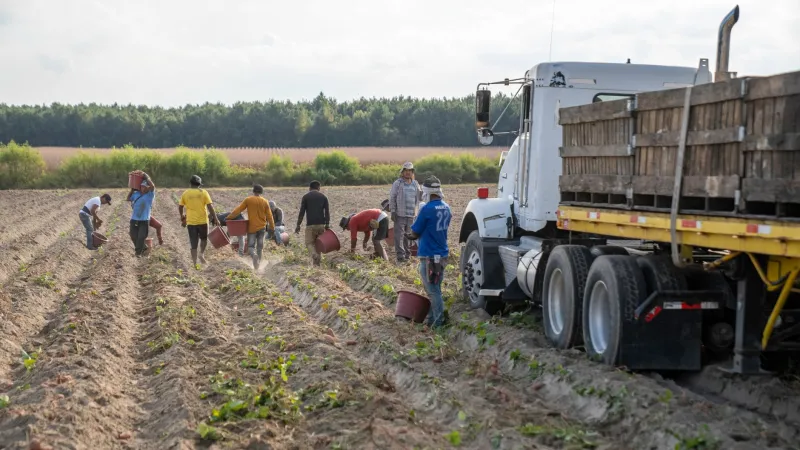
Every spring, hundreds of thousands of workers fan across the American landscape to plant, tend, and harvest the crops that fill grocery shelves from Maine to California. They move with the seasons. They negotiate contracts that last a single harvest cycle. They operate under arrangements that rarely generate the documentation required by traditional farm registry systems. And when the data collection is complete, they are, for the most part, invisible.
This is the registry gap — a structural blind spot embedded in the way the United States counts, categorizes, and understands its own agricultural workforce. It is not a new problem. But as farm data becomes increasingly central to resource allocation, labor policy, and industry forecasting, the consequences of this omission are growing more difficult to ignore.
Who Gets Counted and Who Does Not
Conventional farm registries are designed around a relatively stable set of assumptions: a fixed parcel of land, a named operator, a defined set of commodities. That model works reasonably well for owner-operators running multi-year enterprises. It works far less well for the enormous ecosystem of agricultural labor that surrounds those operations.
Seasonal farmworkers — many of whom migrate across state lines following crop cycles — rarely appear in farm-level data. Their labor is captured, if at all, in payroll records that never make their way into registry systems. Contract growers, who raise livestock or grow specialty crops under agreements with integrators or processors, occupy an especially ambiguous position. They carry much of the operational risk of farming while often lacking the ownership documentation that triggers registry inclusion. Sharecroppers, custom harvesters, and labor contractors add further complexity to a landscape that existing registry frameworks were not built to navigate.
The result is an agricultural census that systematically undercounts the people who perform a substantial share of America's farm work.
The Policy Consequences of an Incomplete Count
Data shapes decisions. When policymakers at the state or federal level design labor protection programs, allocate agricultural extension services, or structure emergency relief funds, they draw on the best available picture of who is working in agriculture and under what conditions. If that picture excludes migrant workers and contract growers, the programs built from it will reflect those exclusions.
Consider disaster assistance programs. When a drought or freeze devastates a region, registered farm operators can document their losses and apply for relief through established channels. Seasonal workers who were employed on those farms — and who may have lost months of expected income — have no equivalent pathway rooted in agricultural registry data. Contract growers, whose financial exposure is real but whose operational footprint is poorly documented, often struggle to demonstrate eligibility for programs that were designed with owner-operators in mind.
The same dynamic plays out in workforce planning. Agricultural labor shortages have become a persistent concern across multiple commodity sectors. Yet the data infrastructure that might support a rigorous, registry-based analysis of where labor demand is concentrated, how it shifts across seasons, and which contract arrangements are most common remains underdeveloped. Planners are left working from estimates and extrapolations rather than verified records.
What a More Inclusive Registry Architecture Could Accomplish
The solution is not simply to expand who gets a line in an existing database. It requires rethinking what a farm registry is designed to capture. A registry architecture that accounts for the full spectrum of agricultural participation would need to accommodate temporary and seasonal relationships, recognize contract arrangements as distinct operational categories, and create pathways for workers themselves — not just landowners — to establish a documented agricultural identity.
Some regional efforts are already pointing in this direction. County-level farm databases in several agricultural states have begun experimenting with contractor registrations that capture the relationship between an integrator and a contract grower without requiring the grower to hold title to the land. Labor advocacy organizations in the Southeast and Pacific Northwest have piloted worker-level registry tools that allow seasonal employees to build a documented work history that persists across employers and seasons.
These experiments are modest in scale, but they represent a meaningful shift in how registry systems conceptualize agricultural participation. Rather than treating the farm as the unit of analysis and everyone else as incidental, they begin from the premise that agriculture is a network of relationships — and that understanding that network requires documenting all of its nodes.
The Industry Planning Dimension
Beyond labor policy, the registry gap creates real problems for agricultural industry planning. Commodity processors, input suppliers, and agtech companies all make investment decisions based on their understanding of who is farming, how much, and under what arrangements. When contract growers are absent from registry data, the market intelligence that flows from that data is systematically skewed toward large, vertically integrated operations and away from the distributed network of smaller producers who supply them.
This skew has compounding effects. It shapes where agtech companies direct their marketing, which communities receive extension resources, and which producer segments attract the attention of agricultural lenders. The farms that are well-documented tend to become more visible, more connected, and better resourced over time. Those that fall outside the registry's frame tend to remain there.
Building the Count America's Agriculture Actually Needs
FarmRegistry USA exists on the premise that agricultural data is most powerful when it is comprehensive, verified, and broadly shared. That premise demands an honest accounting of who is currently excluded from America's agricultural count — and a sustained effort to close those gaps.
Seasonal workers, contract growers, and migrant laborers are not peripheral figures in American agriculture. They are, in many commodity sectors, the operational core. A registry system that cannot see them cannot accurately describe the industry it claims to document. And a data infrastructure built on that incomplete foundation will continue to generate policies, programs, and market strategies that miss the people doing much of the work.
Closing the registry gap will require collaboration across federal agencies, state agricultural departments, labor organizations, and the farming communities themselves. It will require technical innovation in how registry systems define and document agricultural relationships. And it will require a willingness to expand the definition of who counts as part of America's farming community.
The first step is acknowledging that the current count is incomplete. The second is building something better.